

Walmart Rollbacks & Fragmented Reference Prices
My visit to Walmart started as an inquiry into electronic shelf labels but I uncovered broader pricing inconsistencies across in-store and digital channels
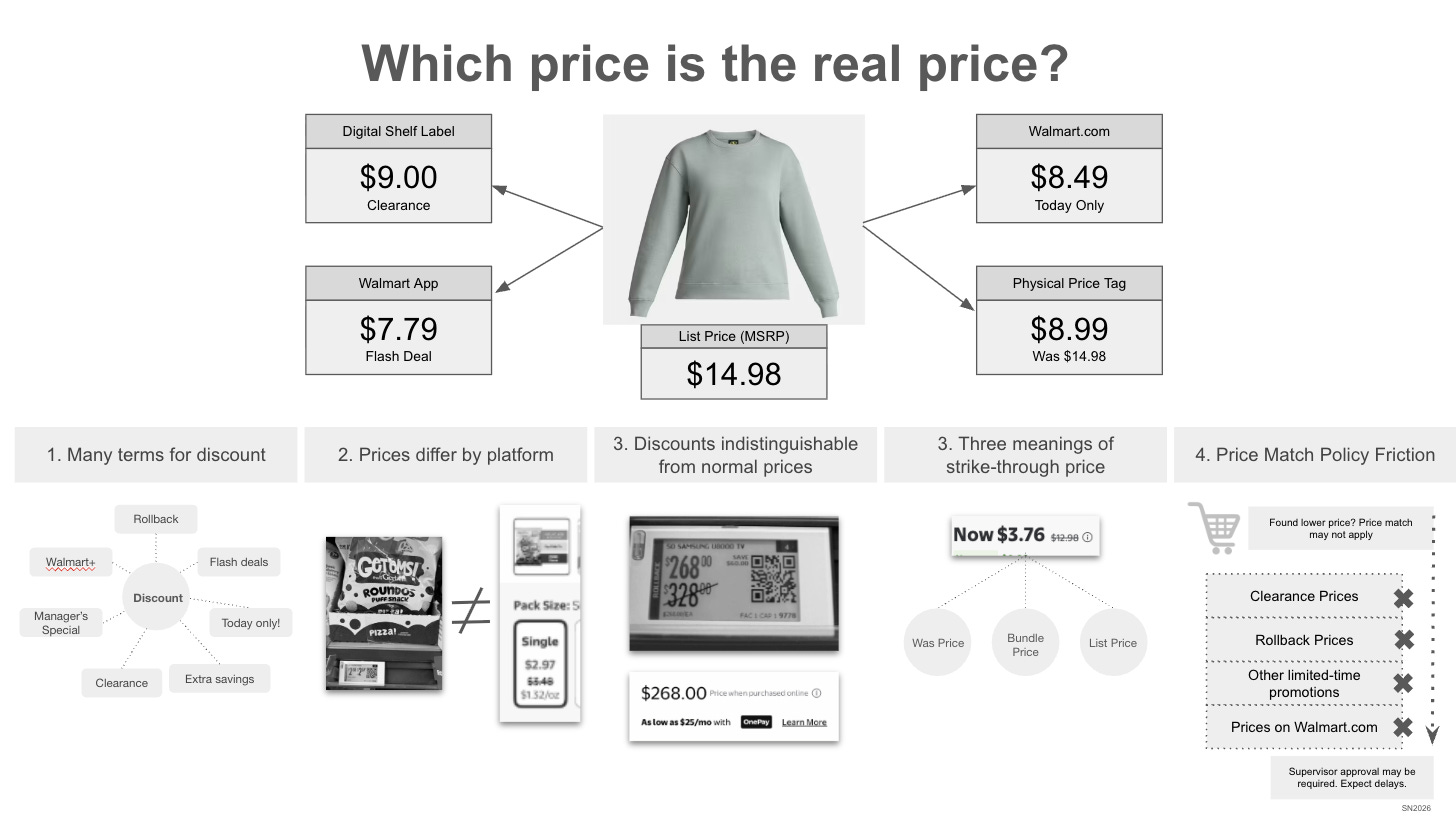
A striking example of participating in the surveillance economy is the erosion of the very concept of price. As retailers adopt digital shelf labels and dynamic pricing, consumers no longer know whether a displayed price is accurate and can’t tell what any given price represents, whether a discount is real, and what baseline measures the claimed savings.
Today, Walmart is rolling out digital shelf labels to 2,300 stores this year, with a big promise: “accurate,” “consistent,” and “clear” pricing. In other words: “New Tech, Better Outcomes.” While some researchers report that electronic shelf labels “have not led to surge pricing in US grocery retail, others have raised concerns about digital tag errors, massive technical glitches, connectivity or device malfunctions, blinking red lights, confusing labels, surveillance pricing, dynamic pricing that raises prices, AI pricing, and price gouging.
To better understand how this works in practice, I visited a Walmart store in the DC area in January and compared prices across digital shelf labels and other platforms (e.g. online and in-app).1
Although I initially set out to examine electronic shelf labels specifically, the visit revealed broader pricing issues that extend across in-store, online, and app-based platforms. Five observations emerged.
#1 – Walmart uses many terms for “discount” or “deal.”
Manager’s special – “signs to highlight price cuts on key items and match competitors’ prices, according to a document viewed by Bloomberg.”
Walmart+ – “Walmart+ is Walmart’s membership program helping members save more time & money with exclusive benefits. With Walmart+, you get free delivery on groceries & more, gas savings, video streaming + so much more!”
The variety of “deal” labels can make it difficult to distinguish between different types of discounts and determine which offers represent meaningful savings.
#2 – Price can differ by platform (e.g. online, in-app, digital shelf label)
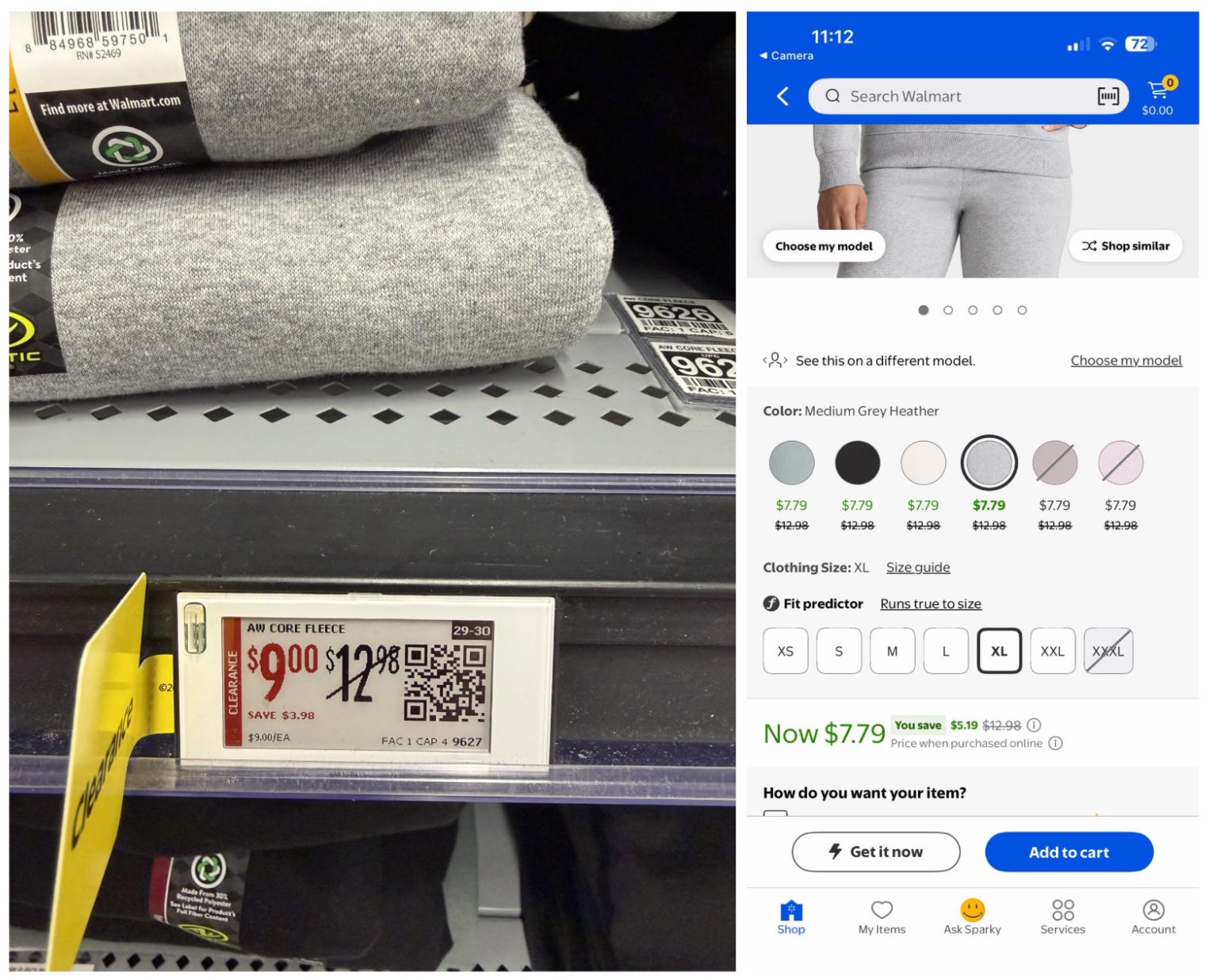
In multiple instances, the price on the digital shelf label did not match the price listed online or in-app. Sometimes the difference was small, just a few cents; others were a few dollars. For example:
Figure 1: A fleece sweatshirt marked “Clearance” for $9.00 in-store was listed online for $7.79. (Figure 1).
Figure 2: Baby puff snacks appeared on the digital shelf label on “Rollback” for $2.08 and were originally priced at $2.97. The online price was $2.97 on Rollback and was originally priced at $3.48.
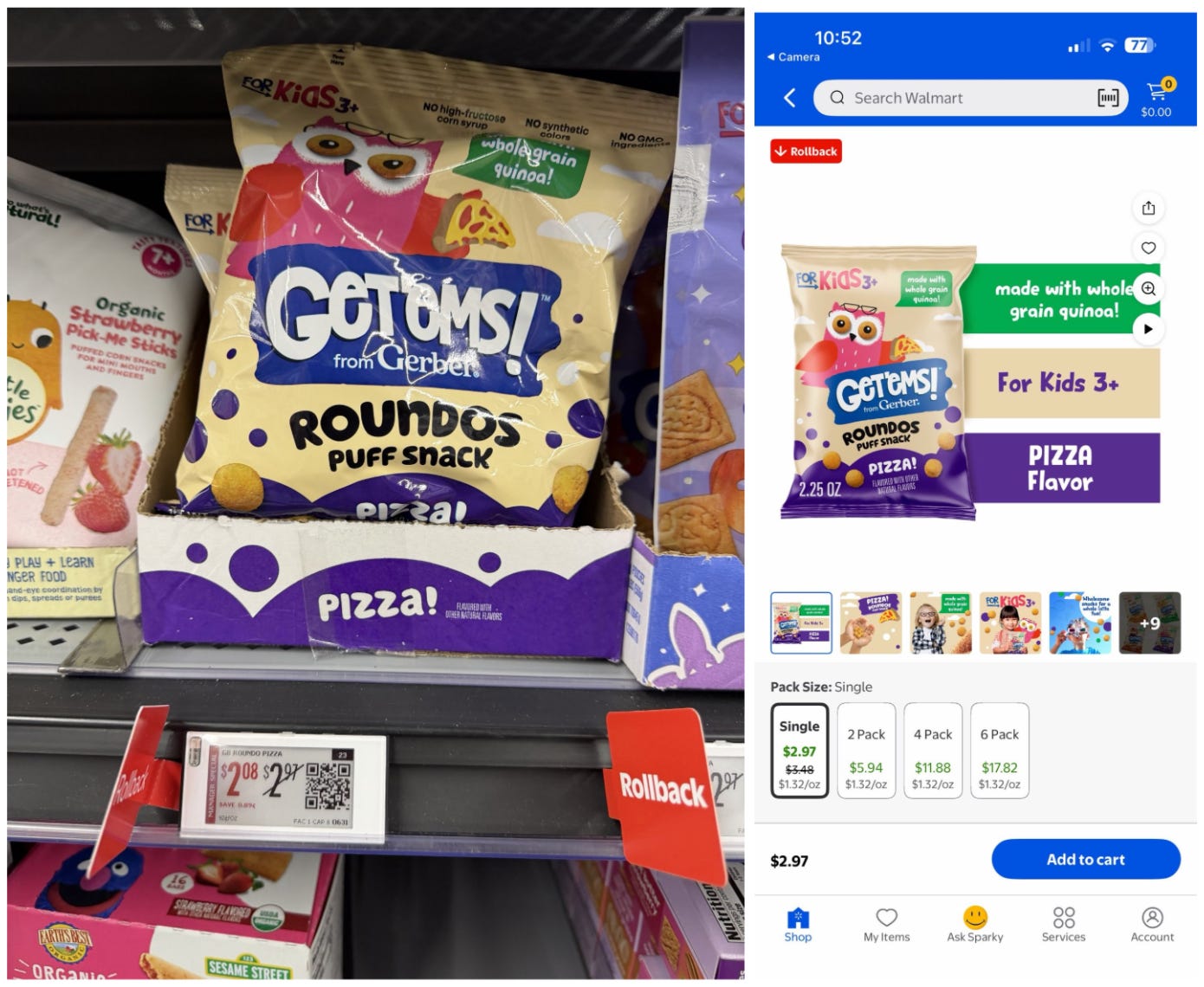
These discrepancies can make it difficult for consumers to identify the lowest available price.
#3 –Some “Discounts” Appear Indistinguishable from Regular Prices
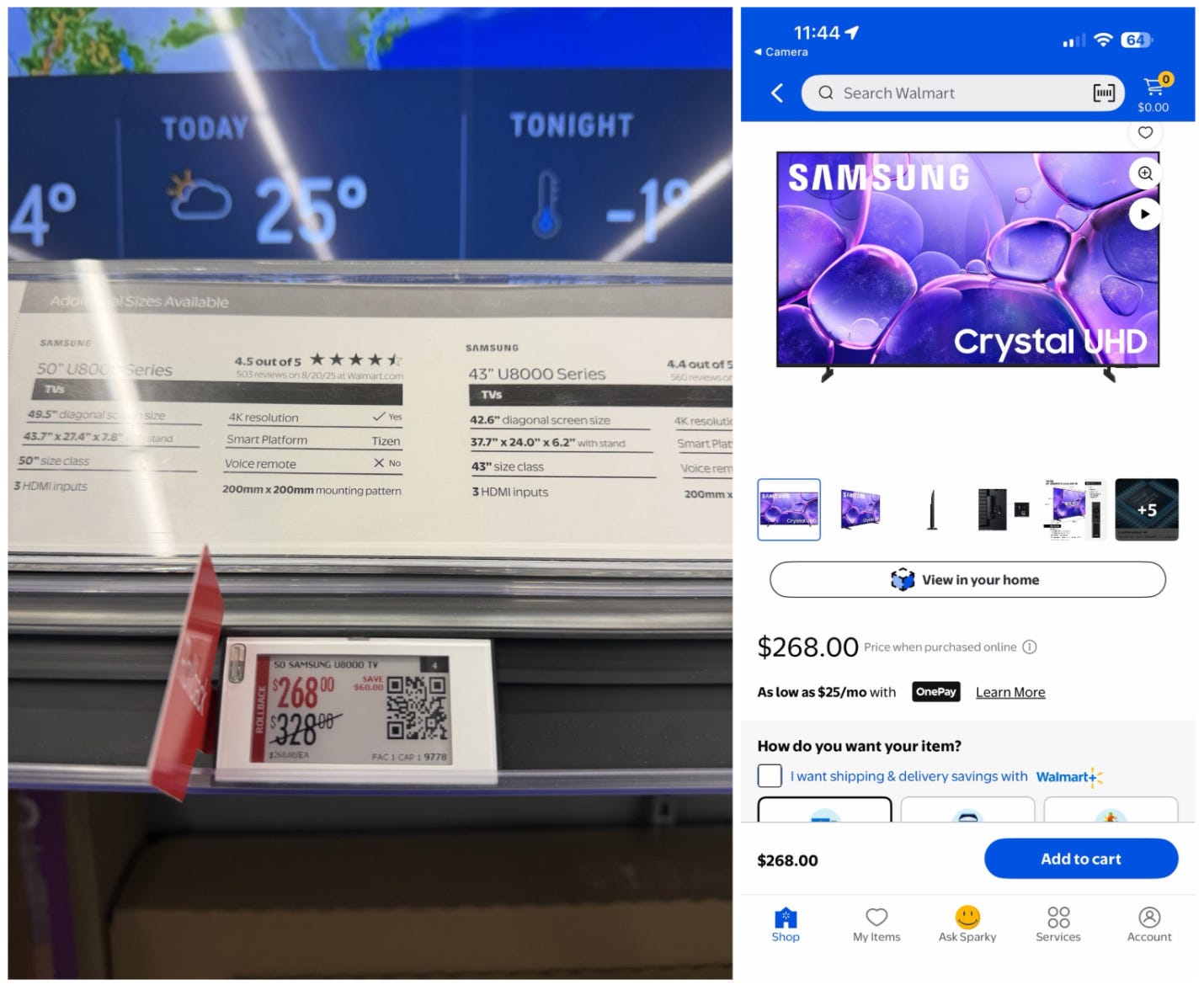
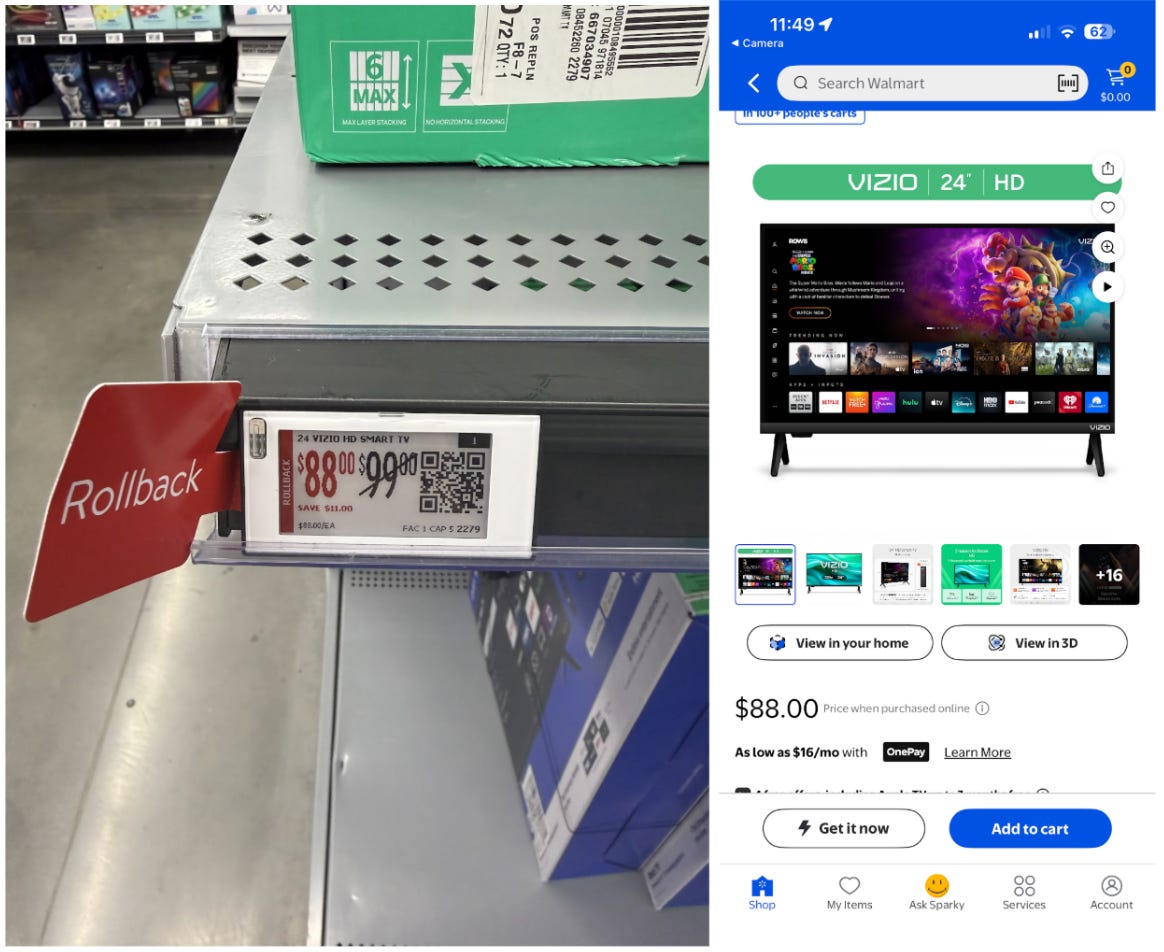
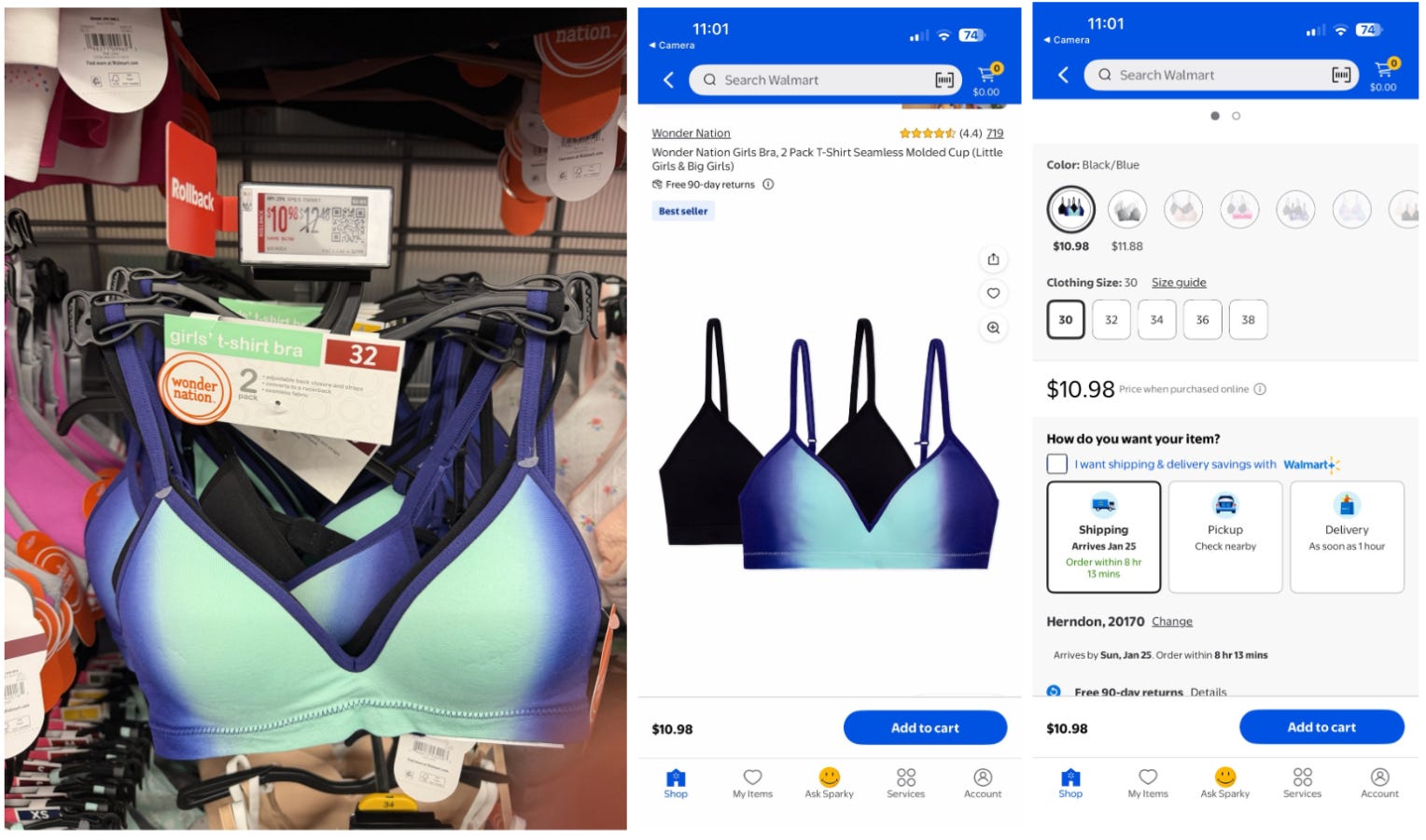
Several products were advertised on “Rollback” in-store but appeared online at the same price without any promotional designation. Examples include:
Figure 3: A 50-inch television advertised as a Rollback from $328 to $268, while $268 appeared online as the regular price.
Figure 4: An HD Smart TV advertised at $88 on Rollback, while $88 appeared online as the standard price.
Figure 5: A girls’ t-shirt bra advertised at $10.98 on Rollback, while $10.98 appeared online as the regular price.
#4 – A “Strike-through” price on a Walmart.com product can mean multiple things
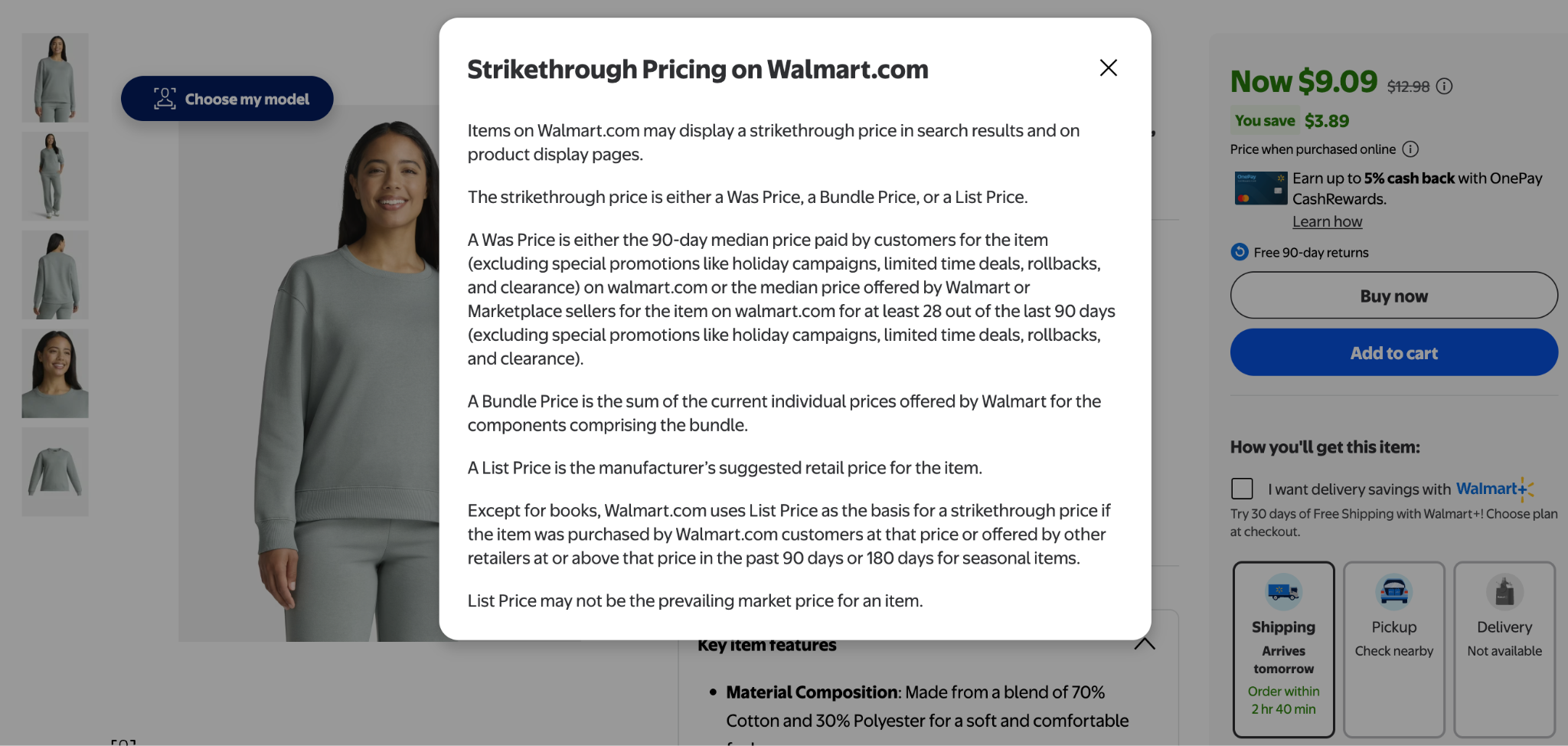
While reviewing an item online, I found that Walmart’s pricing disclosures identify three distinct reference prices:
“Was Price” – “A Was Price is either the 90-day median price paid by customers for the item (excluding special promotions like holiday campaigns, limited time deals, rollbacks, and clearance) on walmart.com or the median price offered by Walmart or Marketplace sellers for the item on walmart.com for at least 28 out of the last 90 days (excluding special promotions like holiday campaigns, limited time deals, rollbacks, and clearance).”
“Bundle Price” – “A Bundle Price is the sum of the current individual prices offered by Walmart for the components comprising the bundle.”
“List Price” – “A List Price is the manufacturer’s suggested retail price (MSRP) for the item [...] List Price may not be the prevailing market price for an item.”
Notably, under “List Price,” Walmart doesn’t say what the prevailing market price is. Is the real price the digital shelf label, the paper tag, the in-app price, the website price, the advertised price in the weekend circular, the price I was shown in search engine results, a chatbot response – or something else?
The existence of multiple reference prices complicates a basic question: What is the appropriate baseline (or in this case, the strike-through price) against which a discount should be evaluated?
#5 – Walmart’s Price Match Policy Limits Consumer Follow-up
Price matching might appear to protect consumers from pricing discrepancies, but Walmart’s policy contains significant limitations.
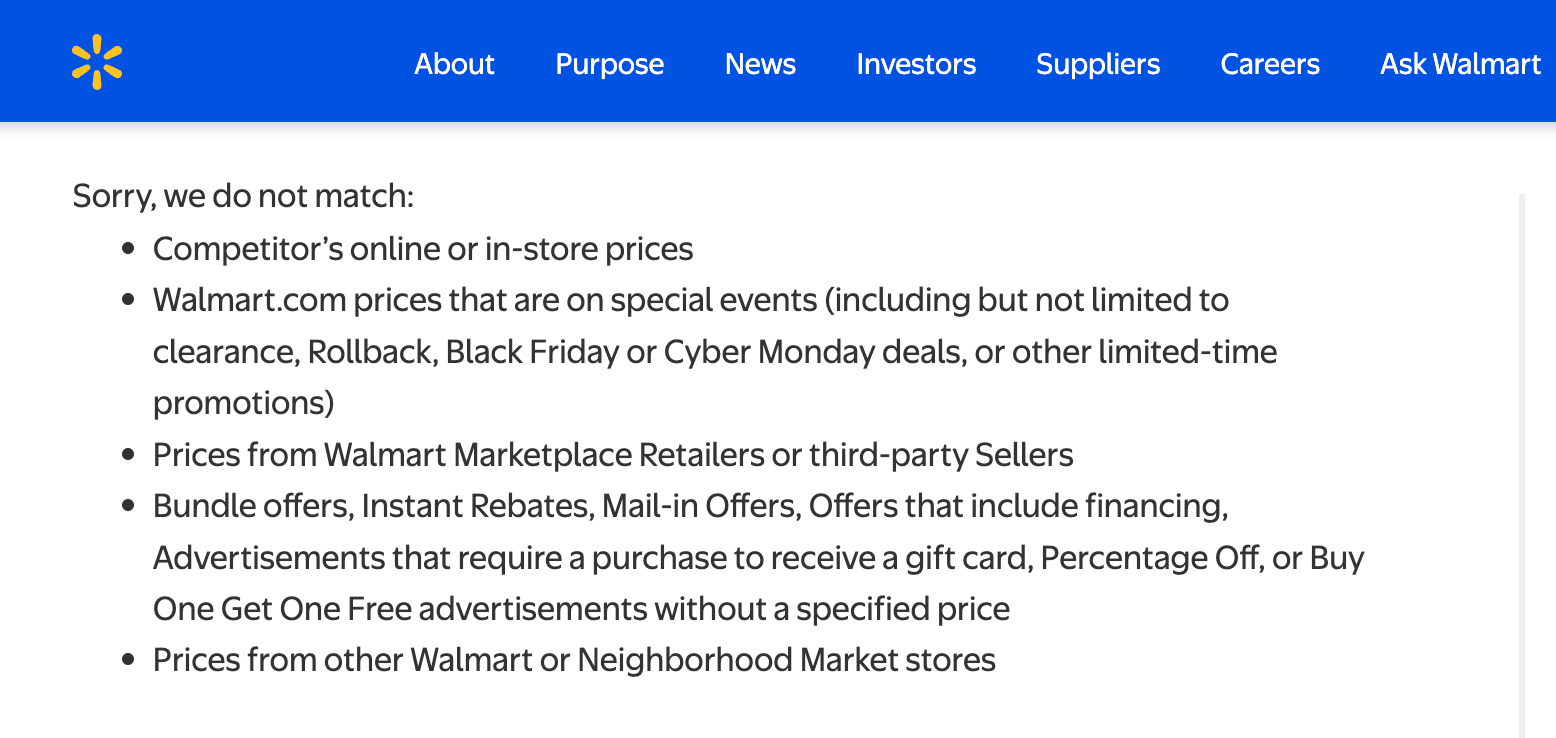
Upon reading Walmart’s price match guarantee – including the detailed list of conditions and limitations, I observed:
Among other restrictions, Walmart states that it does not match prices for reasons including: “prices that are on special events (including but not limited to clearance, Rollback, Black Friday or Cyber Monday deals, or other limited-time promotions).”
It also states, “[Walmart] do[es] not offer any price matching for items offered on our website.” This appears to mean that Walmart won’t price match themselves. If true, even when lower prices exist online or under a promotional offer on one platform (e.g. online website), these policies prevent customers from obtaining the lower price elsewhere (e.g. in store).
Further, it says the item may require “Walmart supervisor approval, which could lead to an extended transaction time to validate the eligibility of the requested price match before the price will be matched.”
What does a price really represent?
These observations point to a broader issue. As retailers adopt digital shelf labels and increasingly sophisticated pricing systems, the central question is no longer simply whether a displayed price is accurate. It is whether consumers have enough information to determine what that price represents, whether an advertised discount is genuine, and what baseline should be used to evaluate the claimed savings.
In an environment where prices, promotions, and reference prices can vary across platforms and change continuously, establishing a “bona fide price” – or a bona fide discount – becomes increasingly difficult.
DFN-005
I was not connected to the store’s Wi‑Fi. To compare prices in store and online, I used my phone to scan the barcodes on the digital shelf labels, which directed me to the product pages in the Walmart app installed on my device. I was logged into my personal Walmart account, which I have used for previous purchases – which may have influenced the prices displayed. In addition, the zip code was inferred based on location access, which could also have affected the prices shown, according to Walmart’s Terms of Use (last updated February 23, 2026).